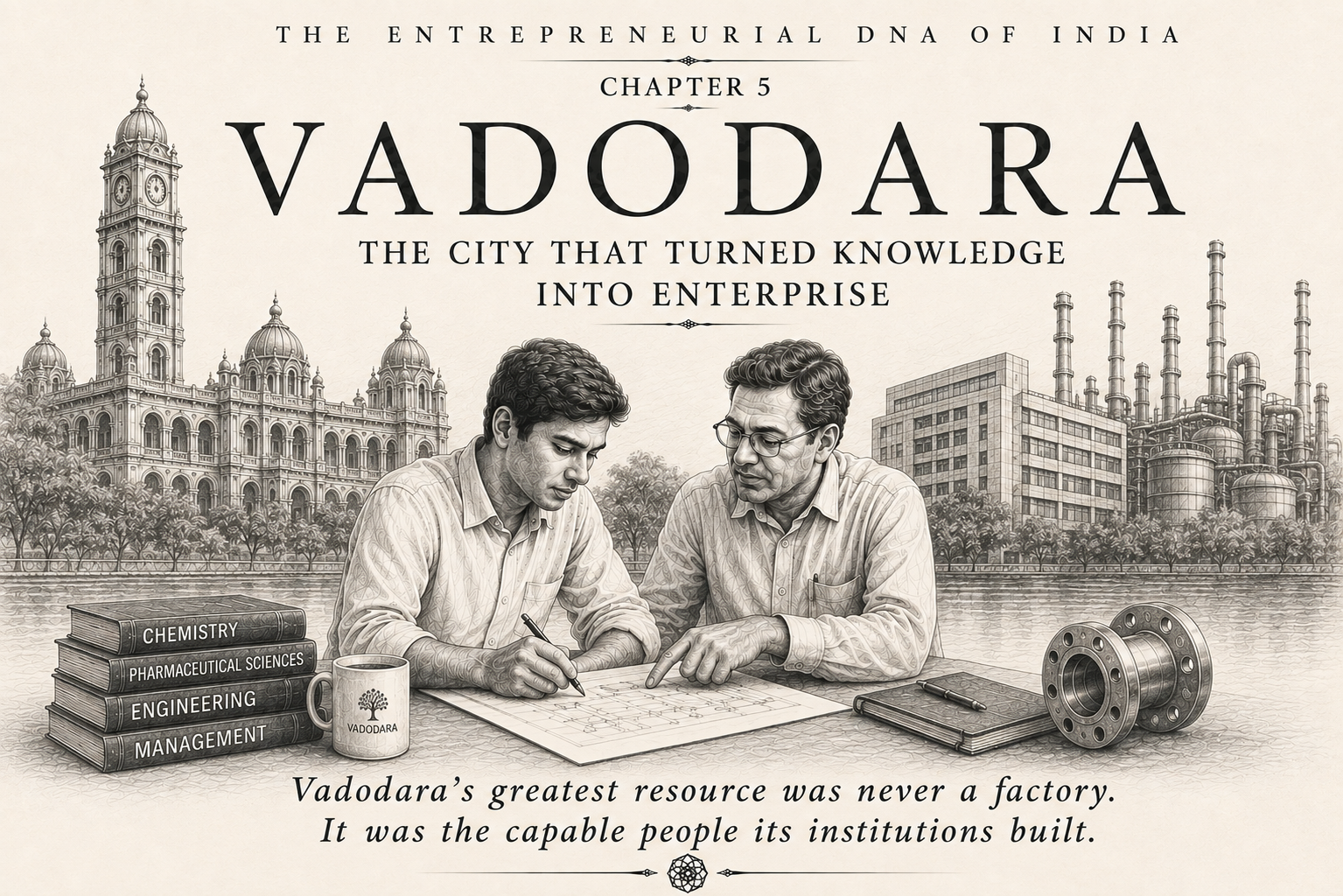
Vadodara’s greatest resource was never a factory. It was the capable people its institutions built.
Vadodara is known for chemicals, pharmaceuticals, petrochemicals, electrical equipment and process engineering. But no single industry explains its entrepreneurial success.
Its true foundation lies in more than a century of investment in education that gradually turned knowledge into Vadodara’s most valuable economic asset.
A City Built on Capable People
Long before industrial estates and petrochemical complexes appeared, the princely state of Baroda made an unusual choice. It invested in education before modern industry.
Under Maharaja Sayajirao Gaekwad III, Baroda introduced compulsory and free primary education in 1906, when access to formal education remained limited across much of India. Public libraries, teacher training, scholarships and institutions of higher learning followed.
This was not merely social reform. It was long-term economic preparation.
Baroda College, founded in 1881, and later The Maharaja Sayajirao University of Baroda, established in 1949, strengthened this intellectual environment. Engineers, scientists, architects, managers and researchers grew within the same city.
When Knowledge Entered the Factory
Vadodara’s industrial journey grew through the meeting of education with industrial opportunity.
Alembic began manufacturing in Vadodara in 1907. The Gujarat Refinery commenced operations in 1965. Over time, major organisations in chemicals, pharmaceuticals, fertilisers, electrical equipment, power and engineering established a strong presence in and around the city.
These organisations did more than create employment. They brought complex technologies, professional management, research practices, quality standards and specialised technical requirements.
Around them grew an ecosystem of smaller manufacturers and specialised SME suppliers offering fabrication, precision components, instrumentation, testing, automation, maintenance and process equipment.
For a local entrepreneur, the opportunity often arrived disguised as a technical problem. A component had to perform more reliably. A process had to become safer. A machine required greater accuracy. A breakdown had to be prevented.
Vadodara’s entrepreneurs responded by learning, adapting and solving. This is how knowledge travelled from classrooms into factories, and from factories into entrepreneurship.
The Entrepreneurial DNA of Vadodara
At its best, a Vadodara enterprise does not merely sell a product. It sells the knowledge behind that product.
A fabricated component may appear to be only metal. Its real value lies in understanding its material, tolerance, application and operating environment. An industrial service may look like routine maintenance. Its value lies in diagnosing a problem before it becomes an expensive failure.
A pharmaceutical product requires chemistry, research, regulatory discipline and consistent quality before it ever reaches the market. Many enterprises began not with enormous capital, but with a founder’s deep understanding of a particular product, process, machine or industrial requirement. That expertise became the starting point of enterprise.
Understand before supplying. Solve before selling.
Knowledge became capability. Capability created credibility. And credibility created business.
Vadodara’s Quiet Entrepreneurial Confidence
Vadodara’s entrepreneurial strength is not always loudly expressed. Its confidence often appears through competence rather than visibility.
It can be found in an engineer improving a component that most people will never notice, a pharmaceutical team working for years before a product reaches the market, or a specialised SME whose name may not be widely known but whose work supports a major industrial operation.
This is why Vadodara cannot be understood only through its largest companies. Its deeper strength lies in the network of professionals, researchers, manufacturers, fabricators, technical consultants and specialised enterprises operating around them.
Large organisations created opportunities. Vadodara’s knowledge culture created people capable of responding to them.
Making Knowledge Travel Further
Knowledge creates its greatest economic value when it continues moving: from education into industry, from industrial experience into entrepreneurship, from technical expertise into original products, from research into commercial application, and from the founder’s personal knowledge into an organisation capable of growing beyond the founder.
This is where Vadodara’s next entrepreneurial opportunity may lie. Technical excellence does not automatically create market leadership. A capable business can remain insufficiently visible. A specialised enterprise can depend upon a few customers. Valuable expertise can remain concentrated in one founder, laboratory or technical expert.
The opportunity is not to move away from Vadodara’s knowledge-based character. It is to make that knowledge travel further into original products, protected intellectual property, recognised brands and professionally managed organisations.
As artificial intelligence and advanced manufacturing reshape industry, technology itself will become increasingly accessible. The deeper advantage will belong to people who can understand it, connect it with practical problems and apply it intelligently.
Vadodara already possesses this advantage.
Looking Ahead
For more than a century, Vadodara has turned classroom knowledge into industrial capability and industrial capability into enterprise. Its next chapter can be written by entrepreneurs who convert that capability into innovation, market visibility, stronger organisations and global relevance.
The question is no longer whether Vadodara possesses knowledge. The question is: How far can Vadodara’s entrepreneurs now make that knowledge travel?
Vadodara’s greatest advantage has never been only the machines inside its factories. It has always been the minds behind them.
Knowledge builds capability.
And Vadodara proves that capability can shape the destiny of an entire city.
This article is part of The Entrepreneurial DNA of India, an initiative that explores and documents the distinctive entrepreneurial character of India’s business cities.