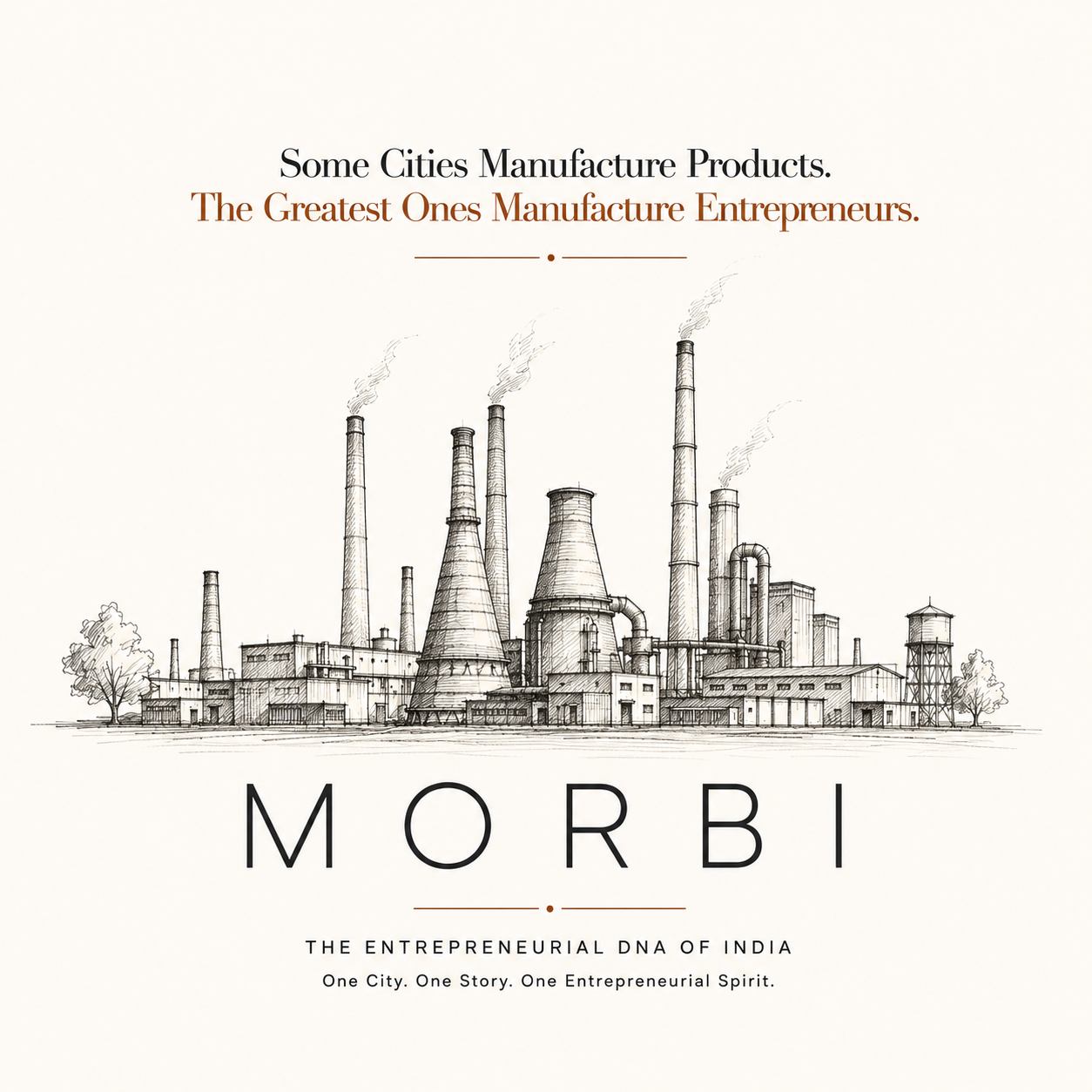
Before dawn, when most of India is still asleep, Morbi is already at work. Kiln fires glow against the dark sky. Trucks wait at factory gates. Across the city, workshop shutters rise, machines start, conversations begin and orders move. This is not an unusual morning in Morbi. This is every morning in Morbi.
Every city leaves its mark on history, some through kings, some through monuments, some through politics. Morbi chose a different path. It chose enterprise. Today, Morbi is recognised across India and around the world for ceramic tiles, sanitary ware and bathware. Yet ceramics tell only part of its story. Wall clocks, paper, laminates, packaging, machinery, chemicals, logistics and solar manufacturing have together made this one of India's most diverse manufacturing ecosystems.
But if we define Morbi by what it manufactures, we miss what truly made it what it is. The products are the outcome. The entrepreneurs are the reason.
The Entrepreneurial Character
No government can manufacture entrepreneurship. No policy can legislate ambition. Only entrepreneurs can—people willing to begin with little, risk family savings, buy one more machine when others hesitate, and rebuild after setbacks instead of surrendering to them. That is how Morbi grew. Not because one entrepreneur succeeded, but because thousands refused to stop trying. One decision rarely changes a city. Thousands of such decisions do.
Business here is more than an occupation. Children grow up listening to conversations about production, dispatches and exports. They visit factories long before they understand balance sheets. Around dining tables, business is discussed not because it is work—but because it is life. That mindset has created something more valuable than manufacturing capacity. It has created confidence. The confidence to invest. To compete. To recover. To believe that a business started in Morbi can earn the respect of customers anywhere in the world.
And that confidence spreads. Every manufacturer creates opportunities for transporters, packaging companies, machinery builders, technicians and service providers. One entrepreneur creates opportunities for many more. That is why Morbi is not merely an industrial cluster. It is an entrepreneurial community.
What Makes Morbi Different
So, what makes Morbi different? Perhaps the answer is surprisingly simple:
- Work begins early. The culture of early starts and continuous effort defines daily operations.
- Decisions are made quickly. Bureaucracy is minimal; action is immediate.
- Markets are respected. Quality and customer satisfaction are non-negotiable.
- Risks are accepted. Calculated risk-taking is part of the entrepreneurial DNA.
- Problems are solved. Challenges are met with pragmatism and innovation.
- Tomorrow is trusted. Long-term thinking guides investment and strategy.
These qualities were not inherited. They were earned. And they were tested.
Resilience Through Adversity
In 1979, the Machhu Dam disaster devastated Morbi. Thousands of lives were lost. Yet the city chose to rebuild—not because it was easy, but because giving up was never part of its character. Brick by brick. Factory by factory. Family by family. That resilience defines Morbi still.
Every successful city eventually reaches a new crossroads. Morbi has reached its next one. The future belongs to cities that not only manufacture more, but innovate more—that build global brands and combine manufacturing with design, technology and sustainability. Morbi has already shown India how to build factories. Its next opportunity is to build institutions. Factories create products. Institutions create generations of entrepreneurs.
Legacy and Future
Its greatest contribution to India is not ceramic tiles or wall clocks or exports. It is the confidence that ordinary entrepreneurs, guided by discipline, courage and perseverance, can build industries that earn the respect of the world.
Long after today's products have changed. Long after today's technologies have evolved. Morbi will continue to inspire India for one reason. It never merely manufactured products. It kept manufacturing entrepreneurs.